
Iowa City Directory Collections
Iowa City directory research is spread across catalogs, shelves, microfilm, and scans. The earliest located item is an 1857 Newberry volume, followed by Holland's 1868–1869 directory and FamilySearch catalog years in 1891 and 1897. An official Iowa City preservation plan cites local directories from 1904 through 1960, but it does not prove that every annual volume survives. Ask the holding library about a specific year.
| Directory set | Years found | Repository | Access route |
|---|---|---|---|
| Newberry and Holland city directories | 1857; 1868–1869 | Newberry Library catalog | Catalog and microfiche; verify before travel |
| FamilySearch Iowa City directories | 1891; 1897 | FamilySearch catalog | Affiliate access may be available at ICPL |
| Local preservation research run | 1904–1960 | ICPL and SHSI leads | Confirm individual volumes with staff |
| Smith's city and county directory | 1922 | Internet Archive | Free page images and OCR |
| Iowa City telephone books | About 1900–1962, in runs | Library of Congress and ICPL | Digital sample and local microfilm |
| University directories and Herd books | 1904; 1911–12; 1922–2013 | University of Iowa Archives and ICPL | Catalog, archive, and library access |
No official source located the last printed Iowa City city directory or a complete reverse-directory run. The 1922 Smith volume does supply a street-and-avenue section with householders arranged by number. That is a sound address-first source even though the book does not call it a criss-cross directory.
Inside Iowa City's 1922 Directory
Smith's 1922 Directory of Iowa City and Johnson County is the strongest complete online example. Volume VIII runs 476 pages. Edgar Smith published it in Dorchester, Massachusetts, while Iowa Printing Company printed it at 111–115 South Clinton Street. The title page promises far more than an alphabetical resident list: city and county officers, churches, schools, clubs, police, the university, classified businesses, county residents, and householders in street order.
The captured source shows why page images beat OCR alone. Broken words and misspellings can hide a surname, while headings and column position preserve whether an address belongs to a home, office, or advertisement. Search the OCR for variants, then inspect the page.
The county portion goes beyond the city. It can list township, post office, rural route, acreage, and assessed personal property. Preserve each label as printed. Combining all those fields into one modern address would distort the historical record.
Read Iowa City Directory Entries
An Iowa City city directory entry may combine a person's name with work, firm, office, home, telephone, building room, or role in a business. Smith's examples include separate office and residence details. No universal owner or renter flag was found in the inspected 1922 sample, so do not add one by assumption.
| Name or firm | Copy the spelling, initials, title, and suffix exactly as printed. |
|---|---|
| Work or role | May name an occupation, employer, service, partner, proprietor, or manager. |
| Address | Distinguish residence, office, shop, building, room, post office, and rural route. |
| Telephone | Historical subscriber evidence, not proof that every household member was listed. |
| County fields | Township, acres, route, and assessed personal property may appear outside the city list. |
Photograph the title page, abbreviation list, and the entry page. Those three views preserve the publication year, the book's scope, and the local meaning of shortened terms.
- Criss-cross directory
- A section arranged by street and house number rather than surname.
- Householder index
- An address-order list that names the person associated with each numbered house.
- Abbreviation key
- The book's own list of shortened words and symbols, which should control interpretation.
Iowa City Library Directory Desk
The Iowa City Public Library genealogy and local history collection is the practical first stop for an uncertain year. ICPL keeps city directories, phone books, county vital-statistics indexes, cemetery indexes, plat maps, Sanborn maps, yearbooks, school records, newspapers, and obituary tools. The library is at 123 South Linn Street and can be reached at 319-356-5200.
Some access depends on being inside the library. Ancestry Library Edition and FamilySearch Affiliate Library access are in-library resources. Historical Iowa newspapers are unrestricted, while other newspaper products may require a resident card or library access. Bring the exact surname, likely year, and street when possible. Staff can then identify the right shelf, microfilm reel, database, or next archive.
ICPL is open Monday through Thursday 10 a.m. to 9 p.m., Friday 10 a.m. to 8 p.m., Saturday 10 a.m. to 6 p.m., and Sunday noon to 5 p.m. Confirm current hours before a visit.
Iowa City Directory Cross-Checks
Directories provide snapshots. Newspapers and obituaries help explain the change between them. ICPL's digital archive includes 41,858 Iowa City Daily Press pages from 1904–1920 and 38,613 Iowa City Press Citizen pages from 1920–1930. Other runs include the Iowa City Republican, Daily Republican, and the Czech-language Slovan Americky from 1873–1897.
Search a name, address, firm, congregation, and spelling variant. An obituary may identify a spouse, child, church, former address, funeral home, and cemetery. Treat those facts as leads until a deed or vital record confirms the narrow claim. ICPL's Press-Citizen index covers 1961 to the present, and HeritageHub carries Gazette obituaries from 1992 forward.
Note: A missing OCR hit does not mean the name is absent; inspect page images around the likely date and directory spelling.
Iowa City Archives Beyond ICPL
University of Iowa Archives holds university directories from 1904 and 1911–1912, plus later institutional series. The archives also preserve student-produced directories, yearbooks from 1892–1992, and Herd books through 2013. A university listing proves an institutional tie, not a civil home address. Later volumes may also be restricted.
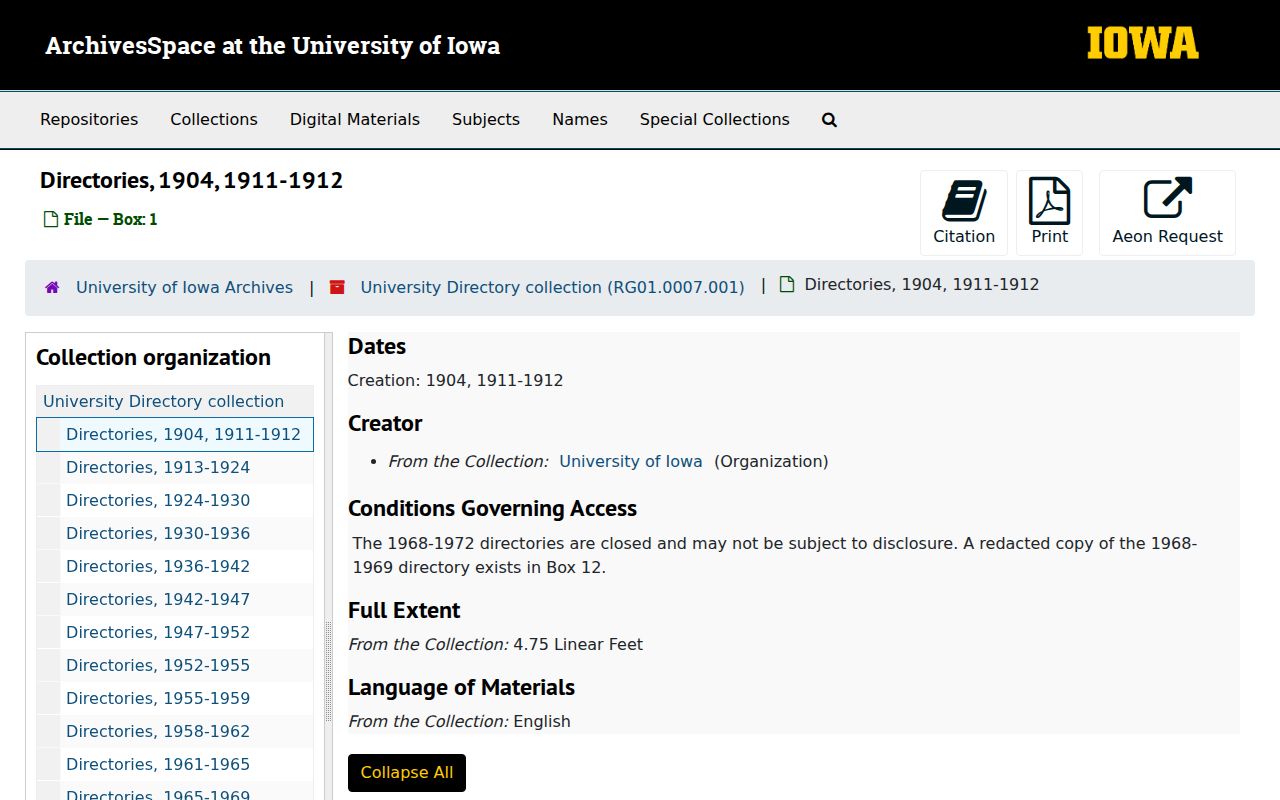
The catalog record helps identify the box and series before contacting Special Collections at 100 Main Library, 319-335-5921. Pair the school year with a department, program, campus address, or yearbook portrait to distinguish people who share a name.
Johnson County Historical Society adds deed books from 1840, atlases, neighborhood maps, farm directories, aerial photographs, Goosetown research, business papers, and oral histories. Appointments are required. Send the curator names and dates; a database check and up to 15 minutes of a specific search are free, while copies and longer reproduction work can cost money.
Missing Iowa City Directory Years
The State Historical Society of Iowa's Johnson County records guide identifies valuable series beyond printed directories. These include the 1844 Iowa City census, assessor material from 1844–45 and 1859–1912, voter registration from 1897–1904, and divorce files from 1851–1914.
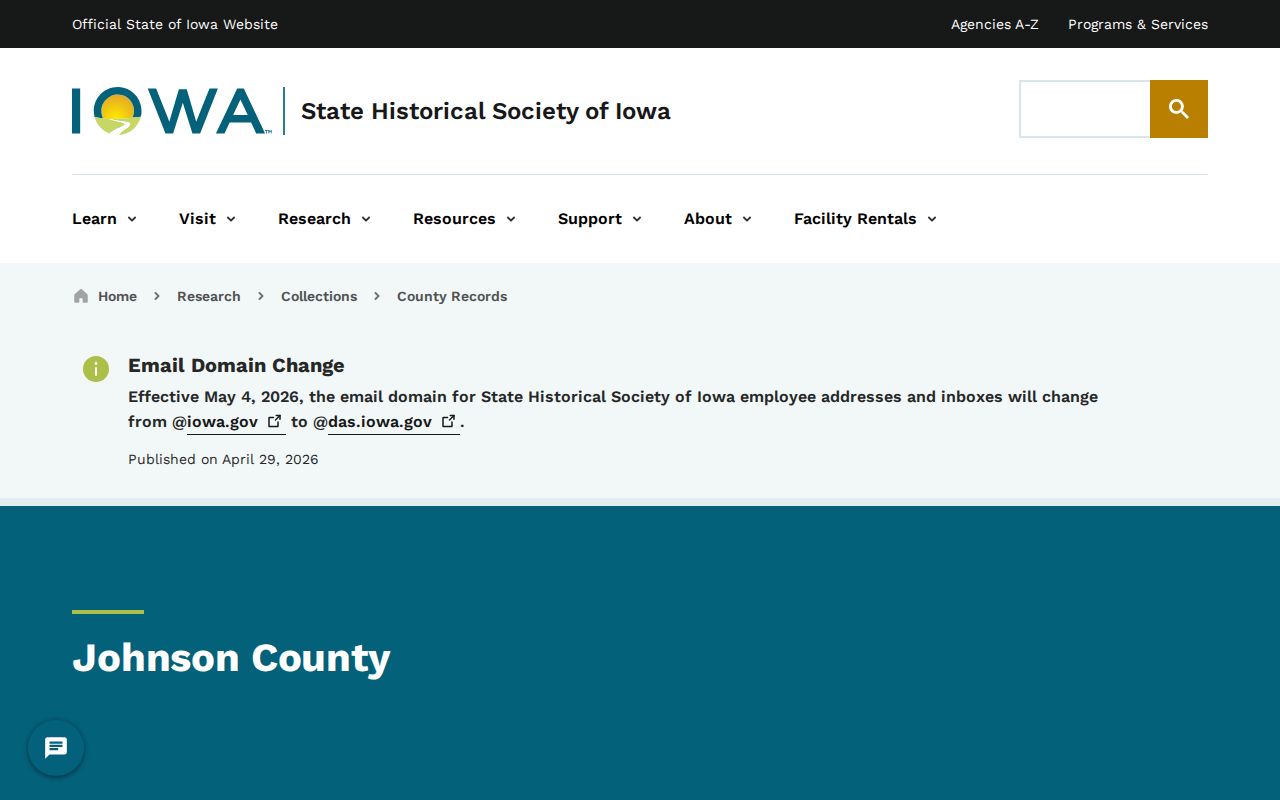
The guide preserves exact series and date ranges, but physical access changed. The Iowa City Research Center closed to the public at the end of 2025 and remained in a collection transition during 2026. Check current instructions before planning an in-person visit. For a missing year, give ICPL, JCHS, UI Archives, or SHSI the name, year, street, and desired collection instead of asking for an open-ended search.
Trace Family in Iowa City Directories
Work one year at a time. A move, death, marriage, or unlisted telephone can all make a person disappear, so absence alone proves nothing. Federal population schedules through 1950 are public in 2026, and Iowa census years can fill other gaps where images survive.
- Choose the closest directory year and record the exact indexed name, address, occupation, and page.
- Check the prior and next available volumes. Note each move, spelling change, spouse, firm, and telephone.
- Use the street-order section to find householders nearby and test whether the house number stayed consistent.
- Pair 1900, 1910, 1920, 1930, 1940, or 1950 directory evidence with the matching federal census.
- Close the trail with newspapers, an obituary, cemetery data, a deed, or a certified vital record.
For modern address-keyed ownership research, use the Iowa City directory by street. Historical books remain best for placing a named person in a specific year. Keep a source ledger with the volume title, date, page, scan URL or call number, exact spelling, and any fact that conflicts with another record.